
Last updated September 23, 2026
Whole-system duct and dryer vent check with before-and-after photos - you see exactly what came out of your vents
That "$99 whole-house special" is a bait ad - the real number appears once they are in your hallway, or the "clean" is a shop-vac at the register. We photograph the inside of your ducts before and after instead.
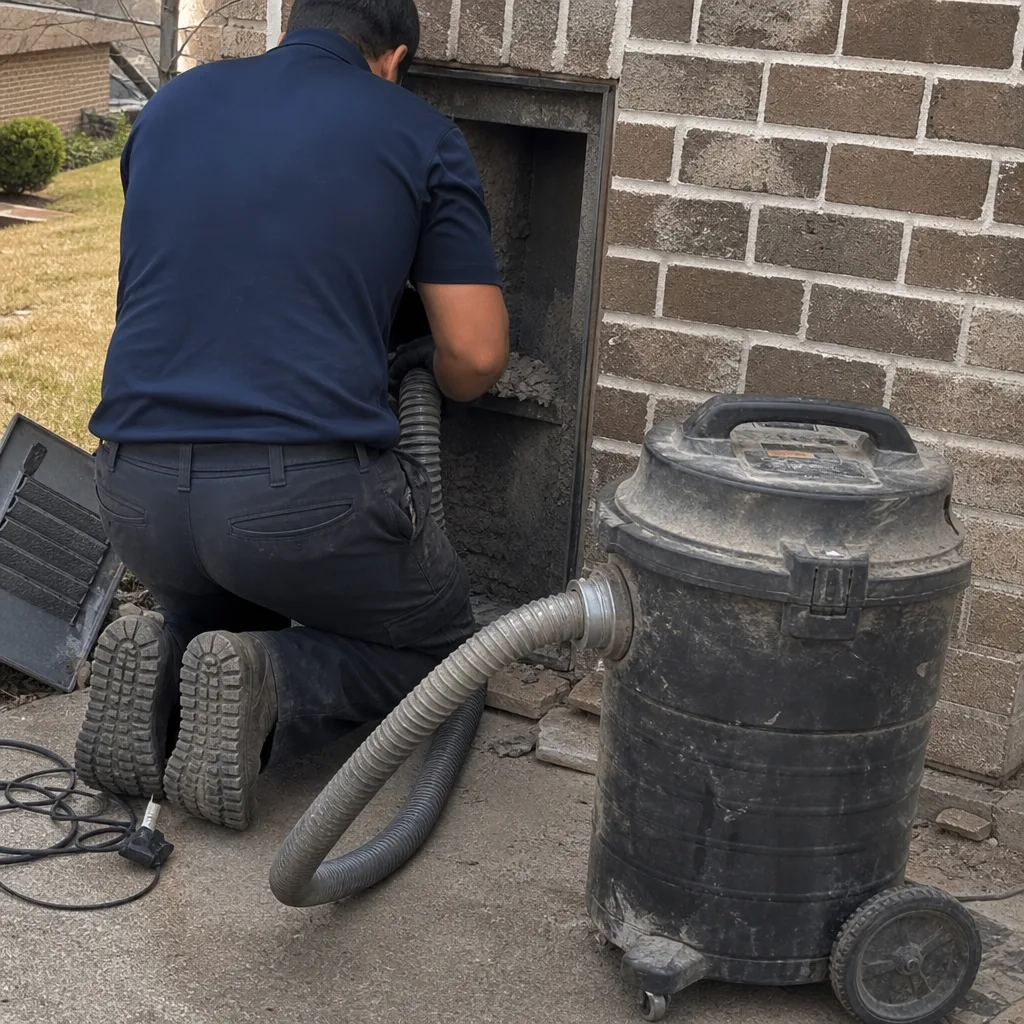 Before
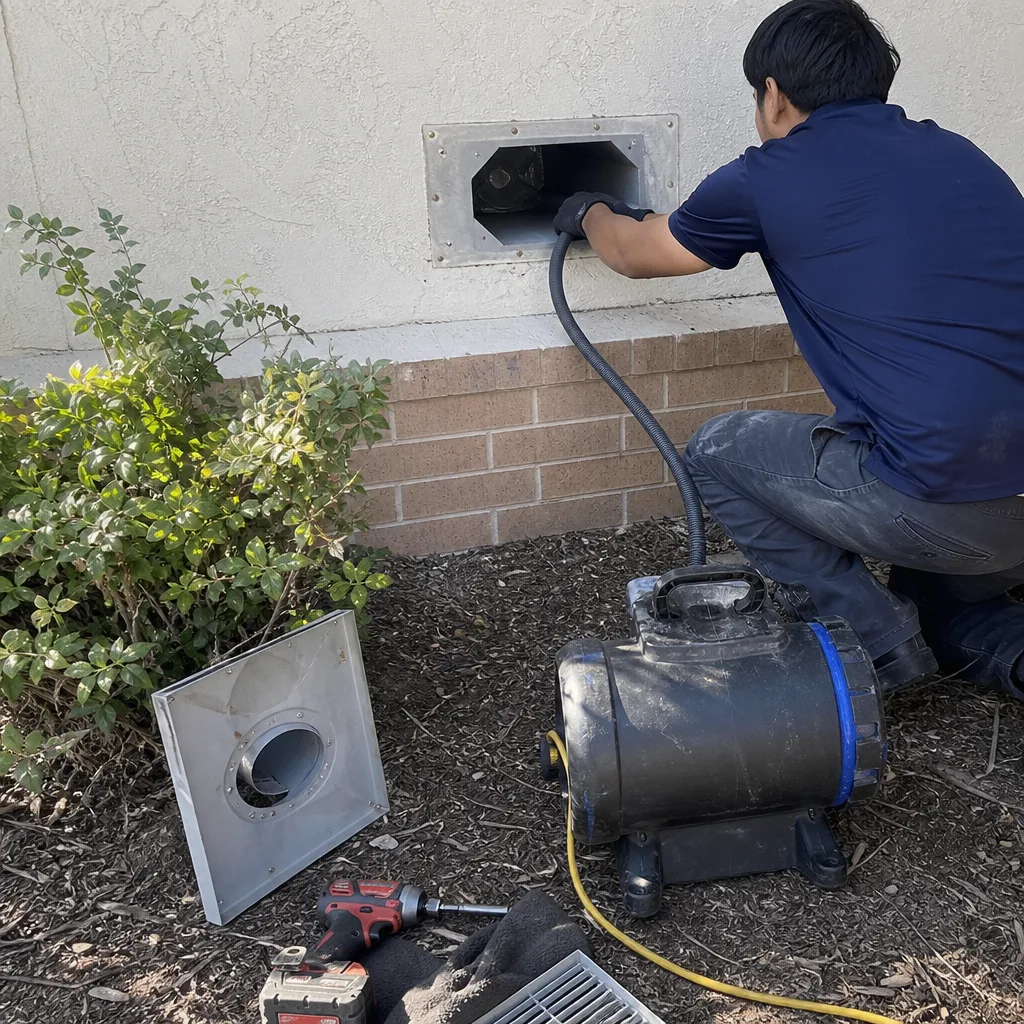 After
After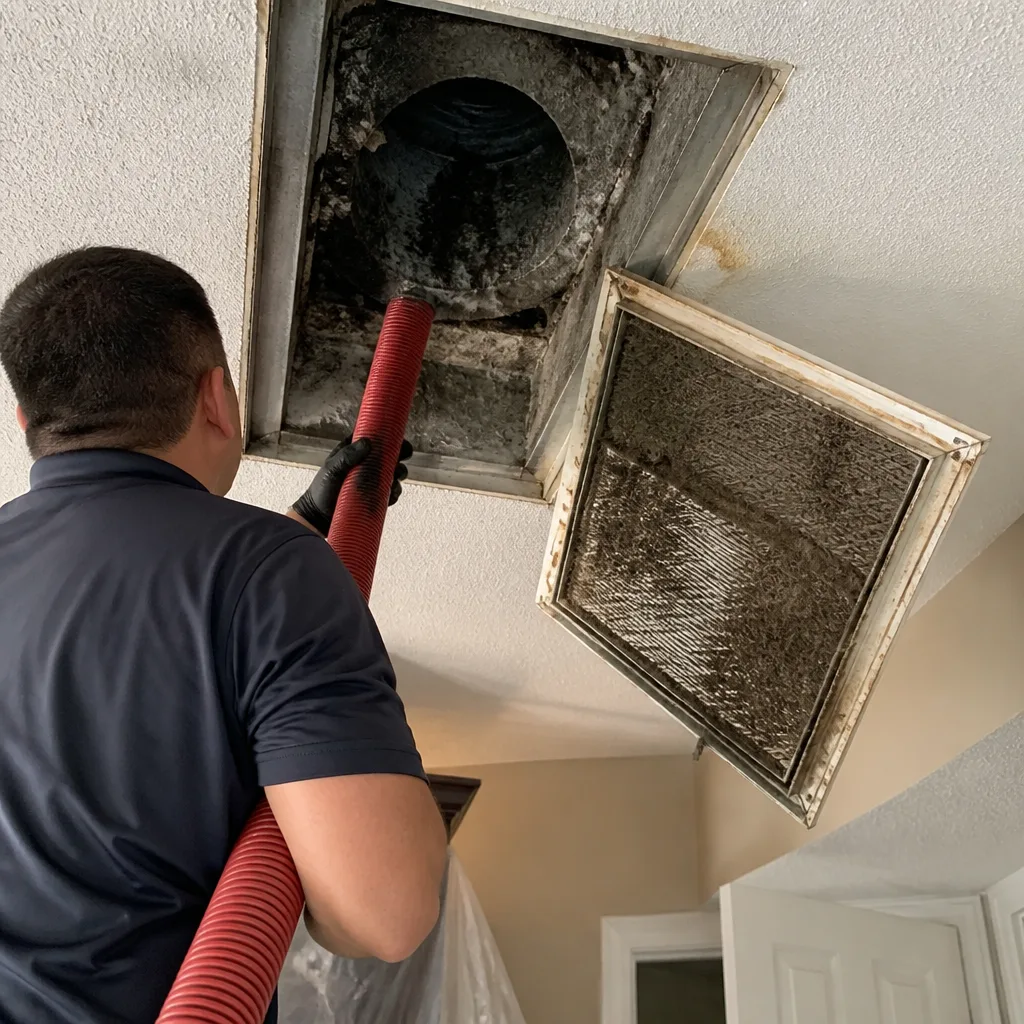 Before
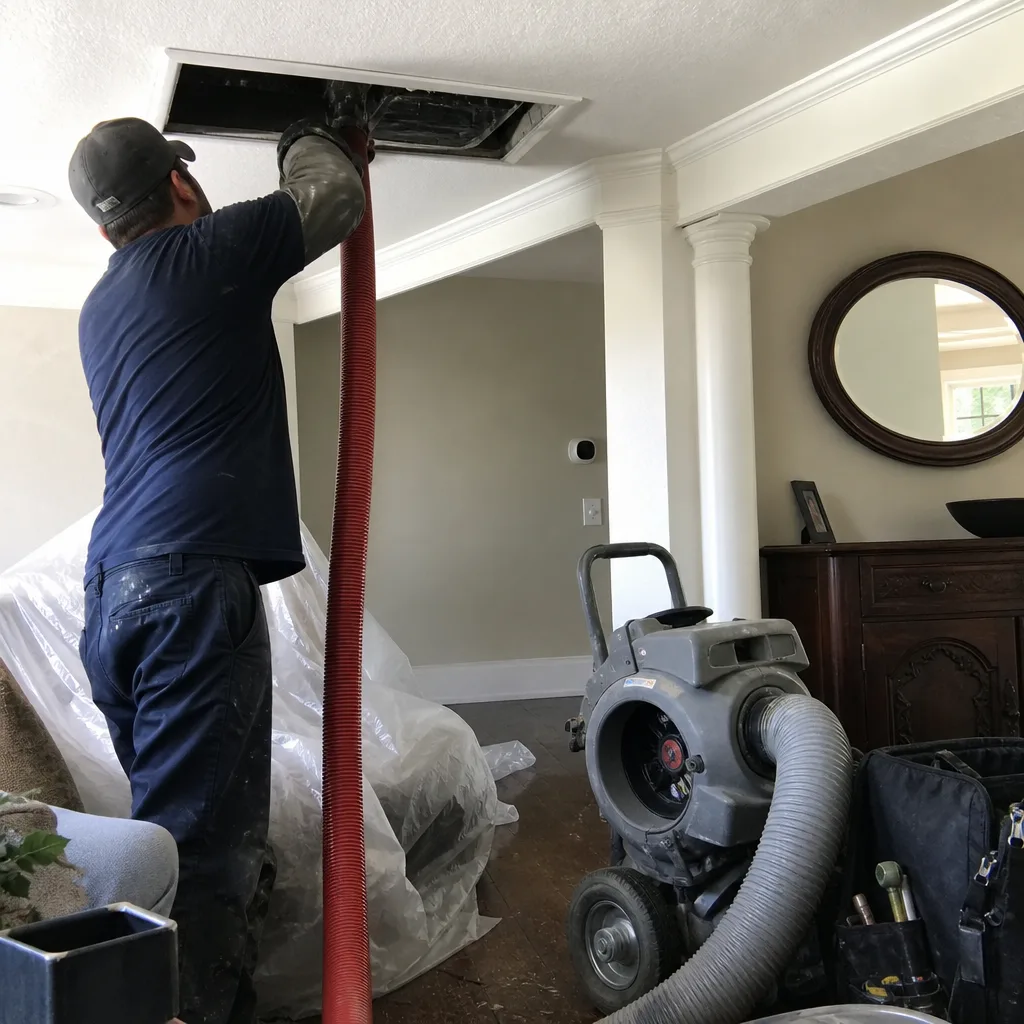 After
After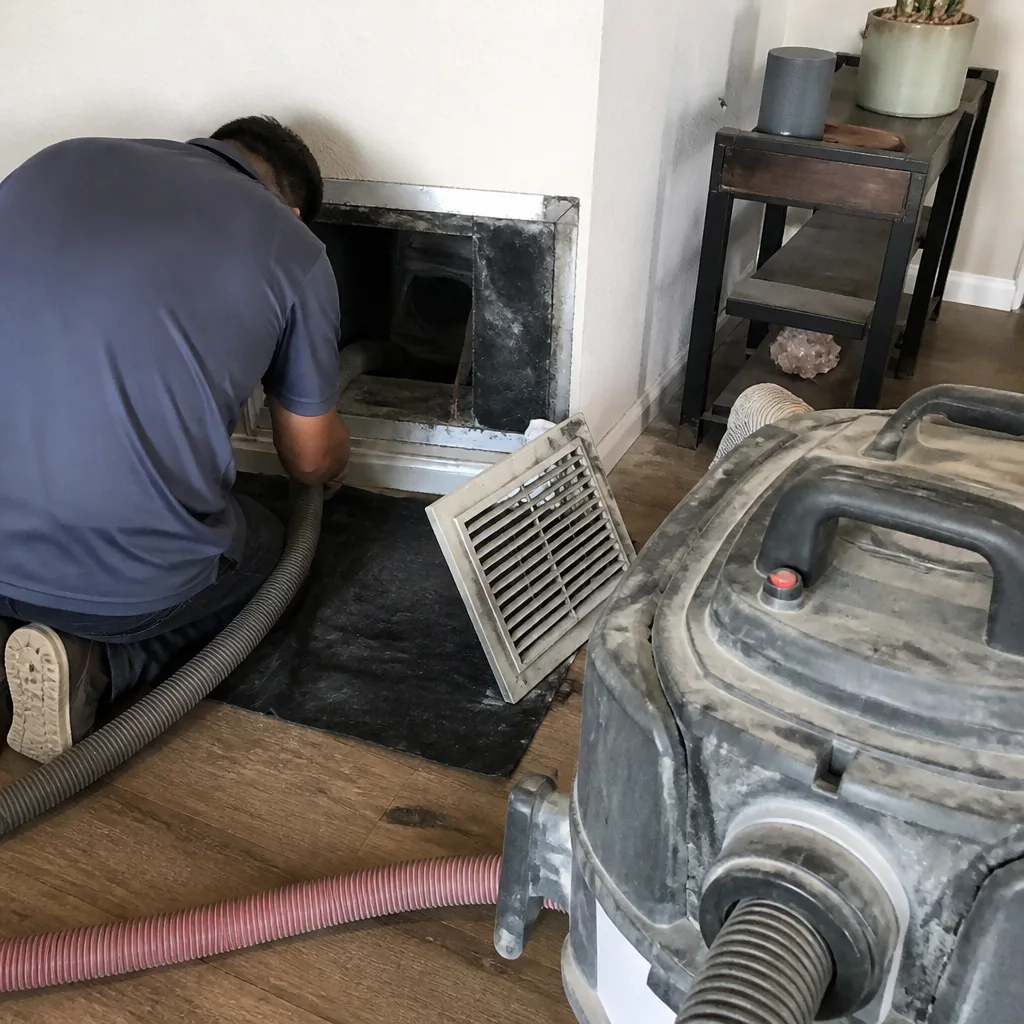 Before
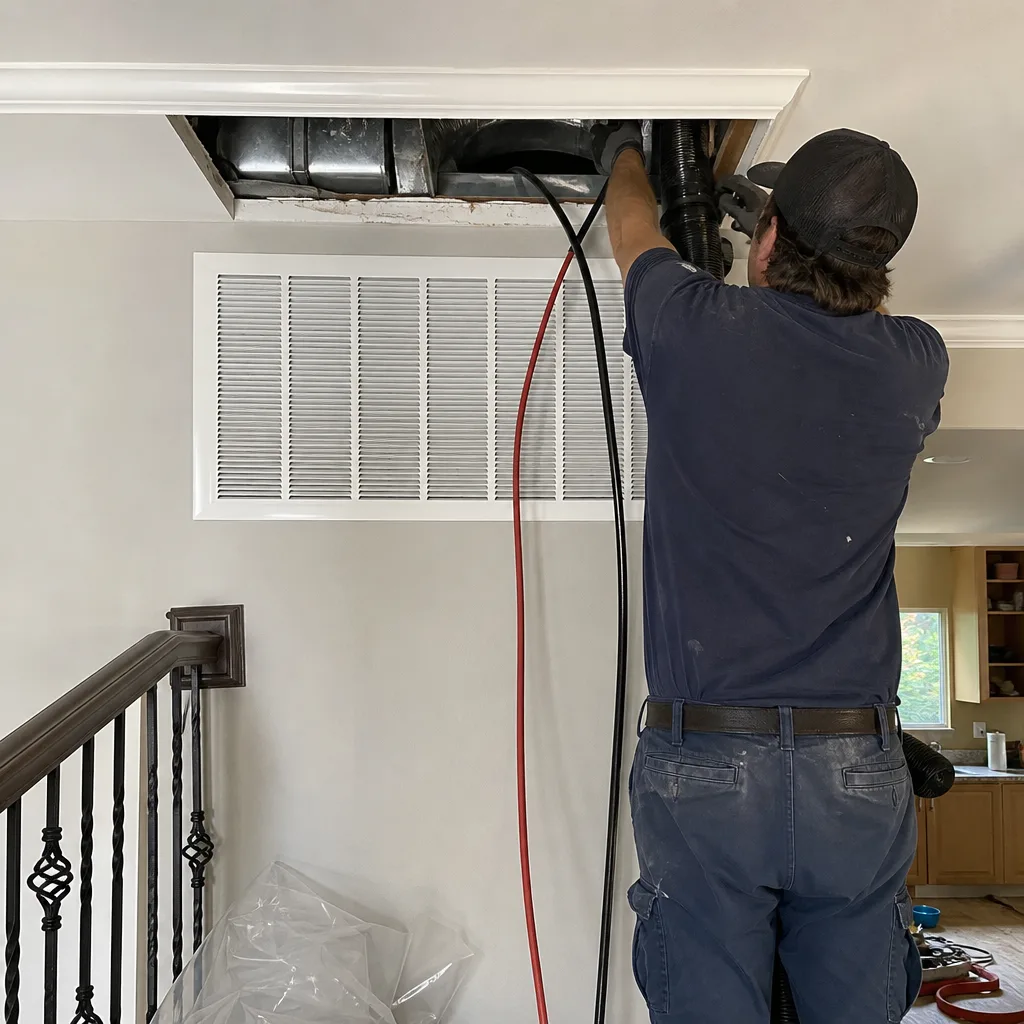 After
AfterThe Complete Guide to Air Duct Cleaning in Plano
The EPA has never recommended a specific cleaning frequency for residential ducts - yet nearly every duct cleaning company in Plano will quote you a “3-to-5 year” rule as if it were code. Here’s what the evidence actually says. Most homeowners in Plano have no baseline: no photo, no measurement, no written record. They pay for a service they cannot verify, then wonder why allergies persist or dust returns within weeks. This guide - alongside our DIY vs Professional Air Duct Cleaning: The Plano Homeowner’s Decision Guide - shows what a documented, verifiable air duct cleaning actually looks like from start to finish, using the specific conditions we find in Plano homes.
Quick Answer
Air duct cleaning in Plano typically costs $350-$850 for a whole-home system, depending on square footage, duct configuration, and contamination level. A proper cleaning includes negative-pressure extraction or contact cleaning with professional-grade equipment, photographic documentation of every duct run before and after, and a written scope of work delivered before any work begins. In Plano’s climate, with clay soil and extended cooling seasons, particulate load often exceeds national averages - but cleaning frequency should be determined by inspection evidence, not calendar rules.
Table of Contents
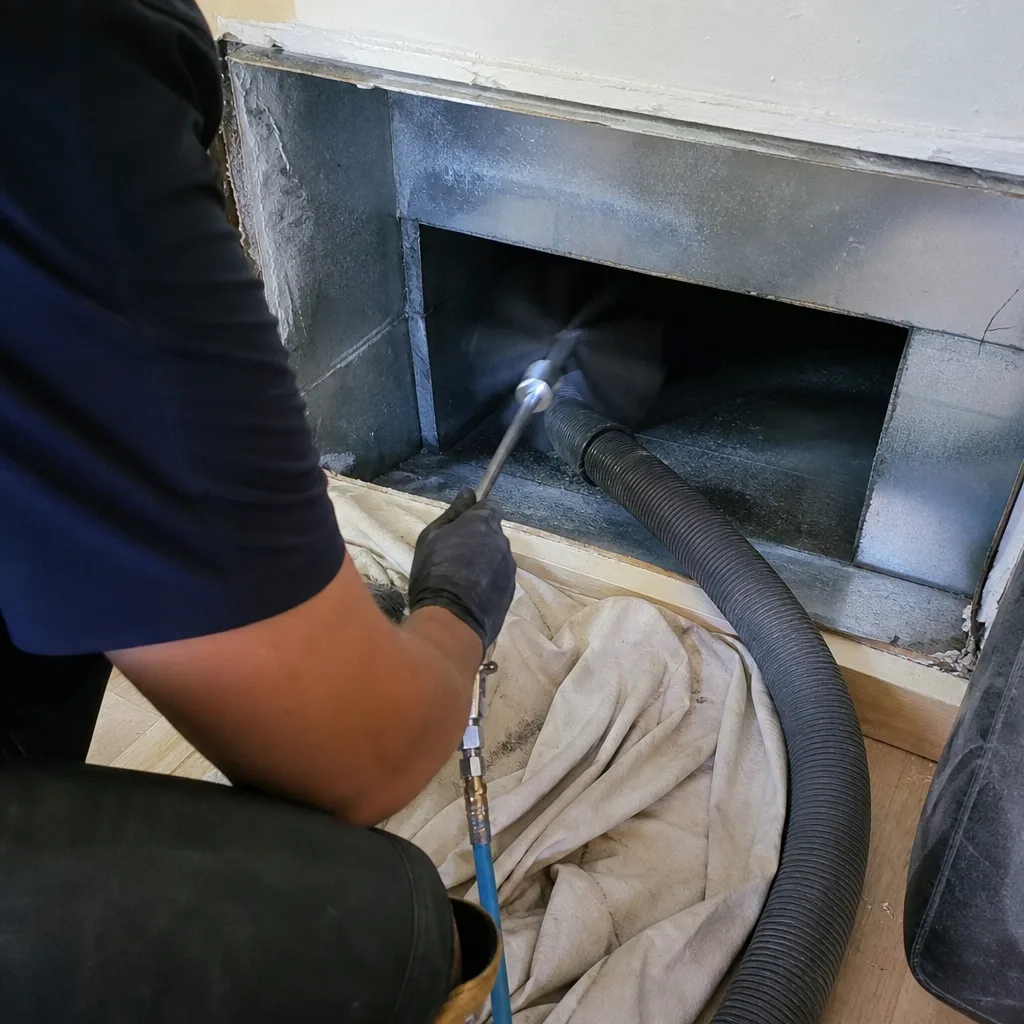
- How Plano’s Climate and Soil Affect Your Ductwork
- What a Camera Inspection Actually Shows Inside Plano Ducts
- Negative-Air vs. Contact Cleaning: Which Method Fits Your System
- What a Written Scope of Work Must Include
- How to Read a Post-Cleaning Report and Verify the Work
- What Air Duct Cleaning Costs in Plano
- Common Mistakes to Avoid
- When to Call a Professional
- Frequently Asked Questions
BeforeAfterHow Plano’s Climate and Soil Affect Your Ductwork
Plano sits on the Blackland Prairie, with heavy clay soil that cracks in drought and swells in rain. That soil doesn’t stay outside. Fine particulate - silica, calcite, organic matter - enters homes through doors, windows, and attic penetrations, then circulates through HVAC systems. The EPA’s national particulate data doesn’t account for this regional factor, but our documented records show the difference.
Here’s what we measure in Plano homes versus what national averages suggest:
| Factor | National Average | Plano Typical |
|---|---|---|
| HVAC runtime (cooling months) | 6-8 hours/day | 10-14 hours/day (May-October) |
| Indoor particulate load (PM2.5) | 12-25 μg/m³ | 18-35 μg/m³ during dust events |
| Duct leakage in homes built 2015-2020 | 15-25% of airflow | 20-30% (tight construction + clay soil stress) |
| Visible debris accumulation at main trunk | 3-5 years to 1/4″ build-up | 2-4 years in Plano’s extended cooling season |
The extended cooling season matters more than most homeowners realize. In Plano, air conditioners run from April through October, often into November. That continuous airflow pulls attic dust, pollen, and construction residue through any gap in the duct system. Homes in Willow Bend, Kings Ridge, and the Legacy West corridor - many built during the 2015-2020 construction surge - show particularly high early-life debris loads from construction-phase contamination that was never fully cleared.
Clay soil creates a second pathway. When soil shrinks, foundation shifts create micro-gaps where ducts pass through slabs or walls. When soil swells, those gaps compress, but the dust already inside remains. We’ve photographed this pattern repeatedly in Plano’s older established neighborhoods and in newer builds alike.
This doesn’t mean every Plano home needs annual cleaning. It means calendar-based rules are unreliable here. Inspection evidence - camera footage, pressure tests, particulate measurements - should drive the decision.
What a Camera Inspection Actually Shows Inside Plano Ducts
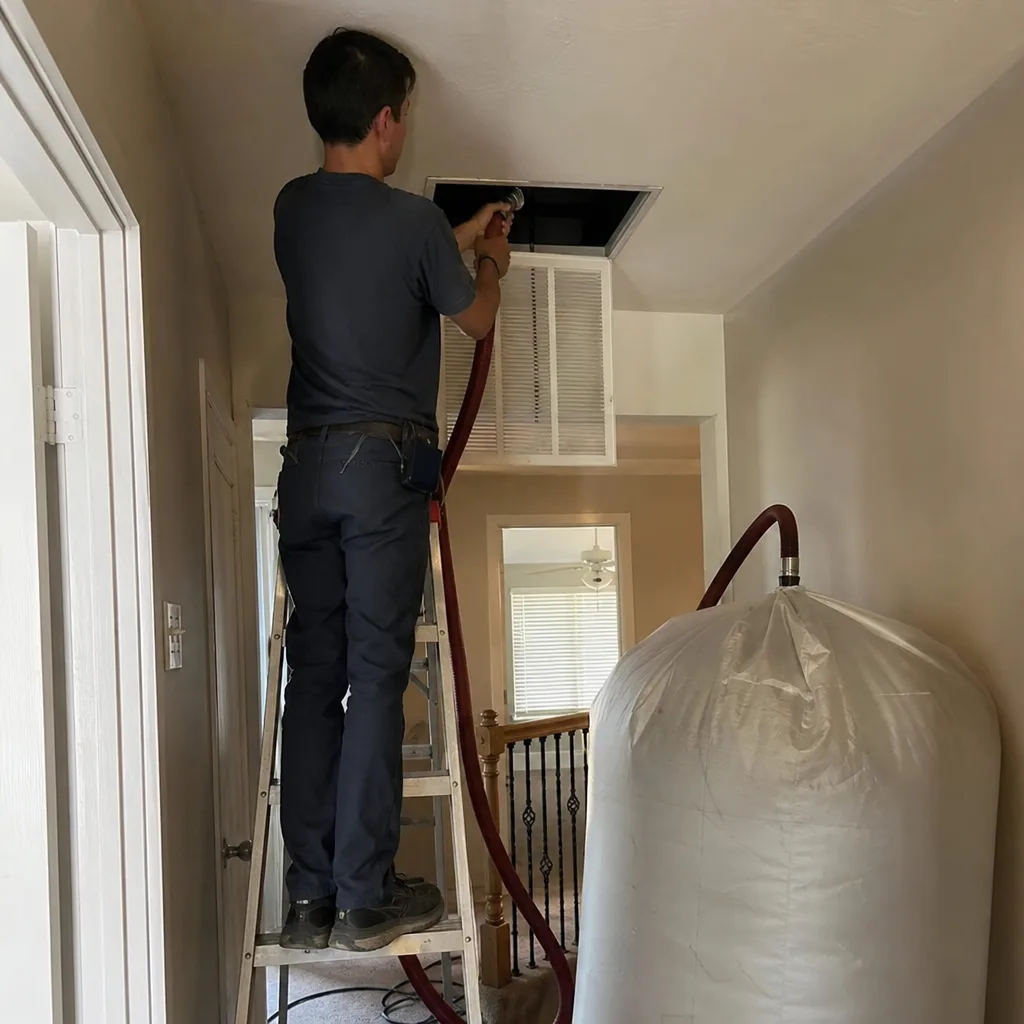
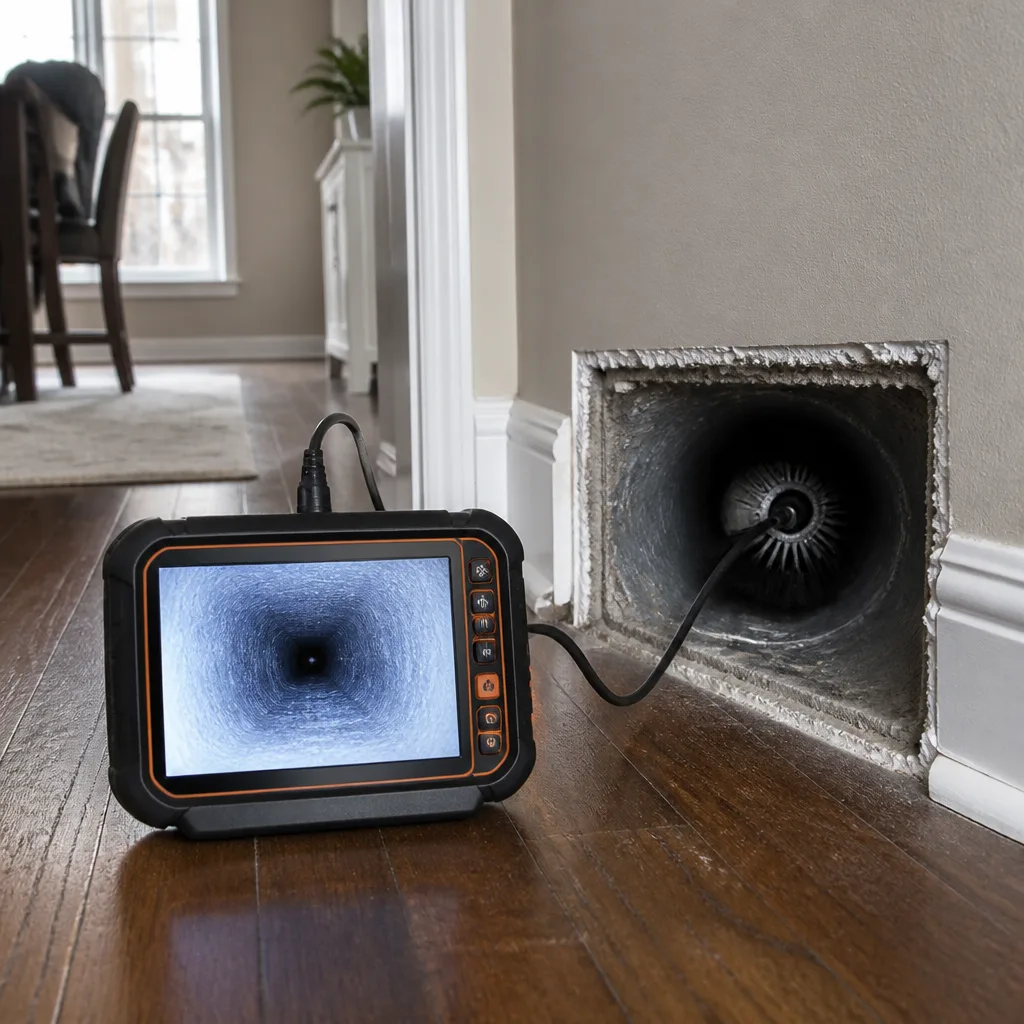
A duct inspection camera is a flexible borescope with LED lighting, inserted through a register opening or created access point. What it reveals determines whether cleaning is warranted, what method to use, and whether additional services (sealing, repair, sanitizing) are appropriate. In our Plano work since 2013, we’ve documented four recurring contamination types that carry different implications.
1. Fibrous Dust and Construction Debris
The camera shows gray, lint-like accumulation on duct floors, often deepest at elbows and transitions. In Plano homes built 2015-2025, we regularly find drywall dust, wood fiber, and insulation fragment - residue from construction that the builder’s initial HVAC startup never cleared. The camera in a home near Prestonwood showed a 3-inch debris build-up at the first elbow off the main trunk, completely blocking airflow to two bedrooms. The homeowner had complained of uneven cooling for three years; the debris explained it.
This material responds well to negative-pressure extraction with agitation. It’s dry, particulate, and mechanically removable.
2. Rodent Evidence
The camera shows droppings, nesting material, or gnaw marks. Plano’s suburban density - homes backing to greenbelts in Russell Creek, Arbor Hills, and Oak Point - creates above-average rodent pressure. Droppings in a duct system are not a cleaning issue alone; they’re a health hazard requiring removal, sanitizing, and exclusion work to seal entry points. We flag this for homeowners immediately and document it photographically before touching anything. The photo record becomes evidence for insurance or warranty claims if needed.
3. Mold-Adjacent Growth
The camera shows dark, patchy staining on duct walls, often near the evaporator coil or in unconditioned attic runs. Plano’s high summer humidity - 60-80% RH during cooling season - creates condensation points in poorly insulated ducts. What homeowners call “mold” is often a mix of dust, skin cells, and microbial growth that requires lab testing to classify. We photograph it, recommend testing through a certified environmental consultant, and do not proceed with cleaning until the moisture source is identified. Cleaning mold without fixing the moisture problem guarantees recurrence.
4. Coated, Oily Residue
The camera shows a thin, adhered film that doesn’t brush off. This typically indicates cooking oil vapor, candle soot, or previous use of unvented combustion heaters. It requires contact cleaning with solvent-safe brushes, not vacuum extraction alone. We note this in the written scope and adjust equipment and pricing accordingly.
Without a camera inspection, a homeowner cannot know which of these - or what combination - is present. The $79 coupon special doesn’t include this step. The documented photo record does.
Negative-Air vs. Contact Cleaning: Which Method Fits Your System
Two distinct cleaning methods exist, and the choice between them should be documented in your written scope, not left to the technician’s convenience.
Negative-Pressure Extraction (Truck-Mounted Vacuum)
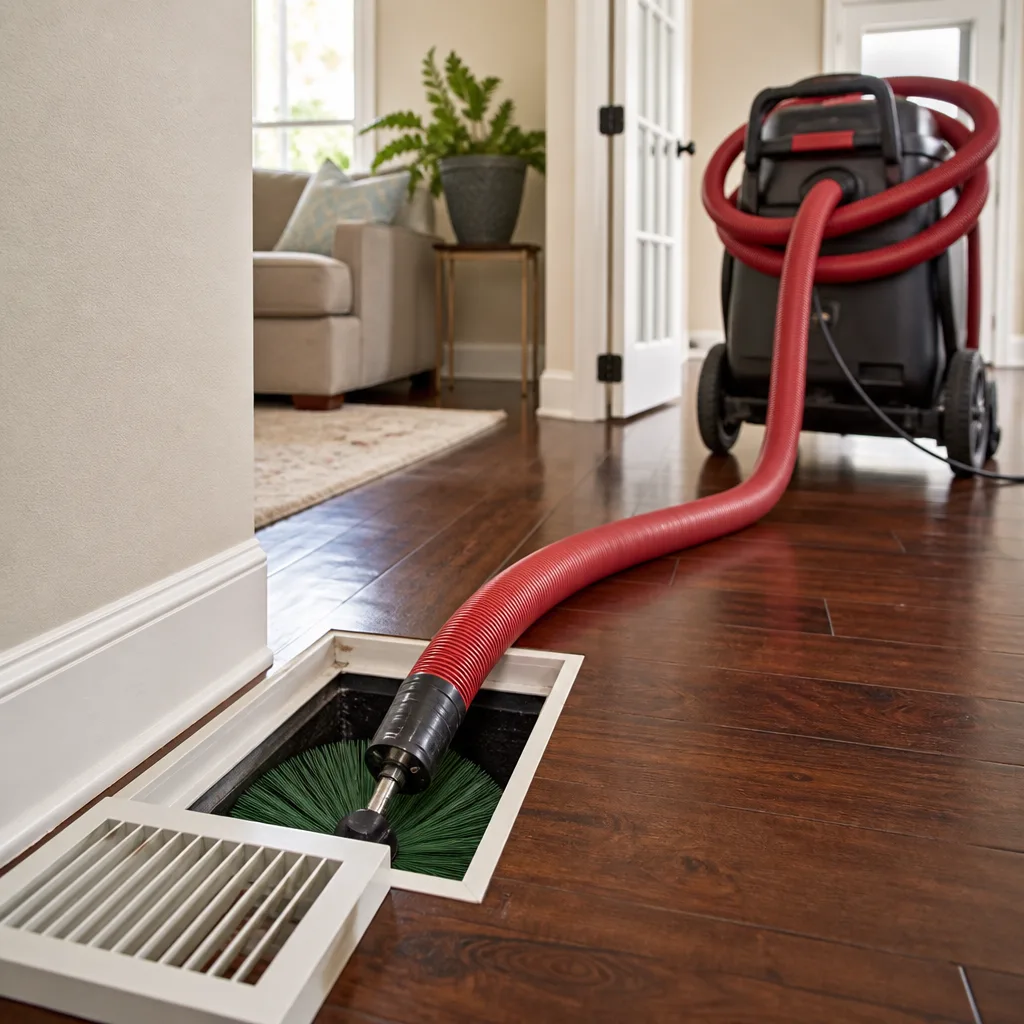
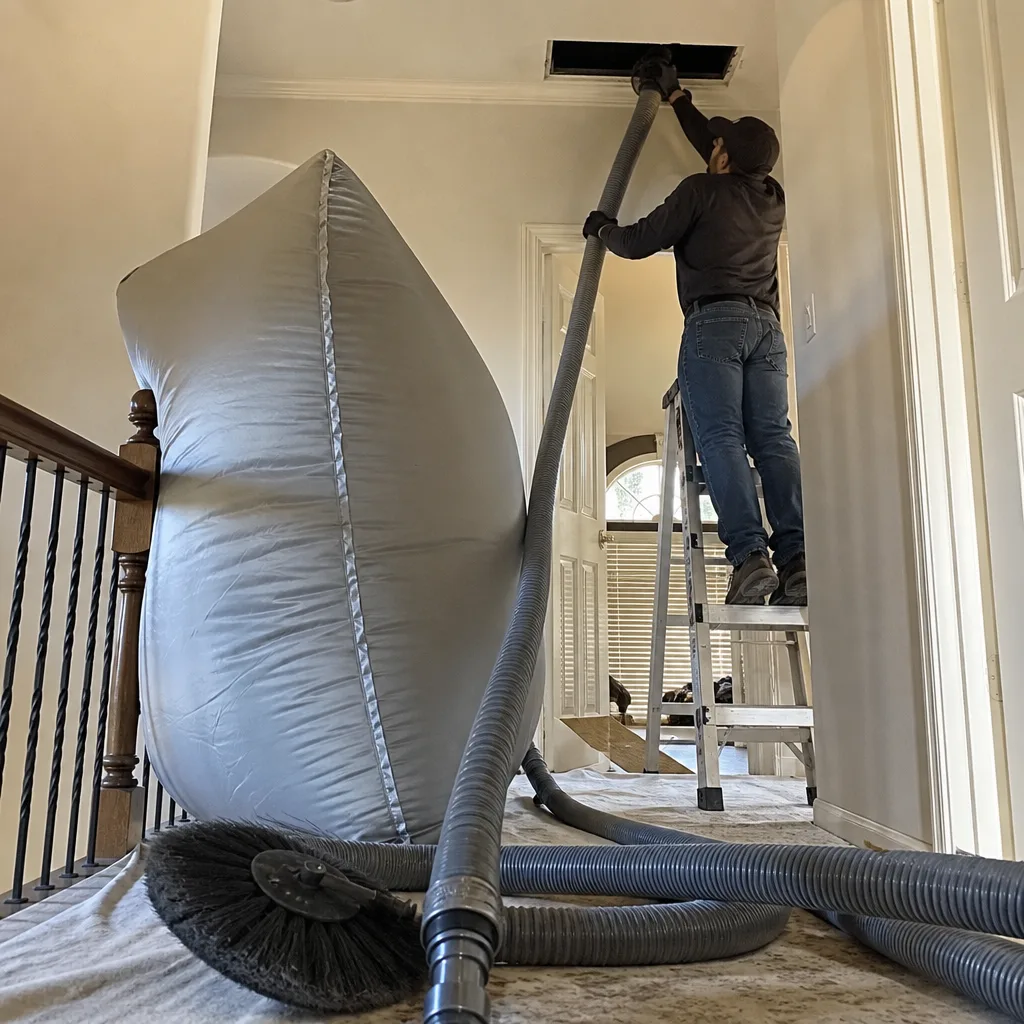
A large vacuum - typically gas-powered and mounted in a service vehicle - connects to your duct system near the air handler. The system is placed under negative pressure (suction), while compressed-air tools or rotary brushes are inserted at each register to dislodge debris. The loosened material is drawn through the ductwork and captured in the vacuum’s filtration system.
Equipment we use includes Nikro truck-mounted systems and Abatement Technologies portable HEPA-negative air machines. These units move 5,000-15,000 CFM, creating sufficient airflow to transport heavy debris without releasing it into the home.
Negative-pressure extraction is appropriate when:
- The duct system is intact, with no significant leaks
- Contamination is primarily dry particulate (dust, pollen, construction debris)
- The home has adequate register access (standard floor or ceiling registers)
- The main trunk is accessible for vacuum connection
Contact Cleaning (Rotary Brush Systems)
A smaller, portable vacuum unit - electric-powered, carried into the home - connects to a rotary brush assembly. The brush physically contacts the duct wall, scrubbing debris loose while the vacuum captures it at the point of disturbance. Rotobrush systems are the industry-recognized standard for this method.
Contact cleaning is appropriate when:
- Ductwork is flexible or damaged, and high negative pressure could collapse it
- Contamination is adhered or coated (oily residue, soot)
- Access is limited (tight crawl spaces, multiple small branches)
- The system requires section-by-section work with visual confirmation
Hybrid Approaches
Many Plano homes - particularly two-story builds in Legacy West, Windhaven, and Twin Creeks with complex zoned systems - require both methods. The main trunk and large returns receive negative-pressure extraction; the flexible branch lines to second-floor bedrooms get contact cleaning with rotary brushes. The written scope should specify which method applies to which duct section, not use generic language like “complete system cleaning.”
We document the method selection in every written scope under Haven Standard Clause 1: Written Price Before Work. The customer knows what will be done, where, and with what equipment, before any panel is removed.
What a Written Scope of Work Must Include
The scope of work is the contract document that defines what you’re paying for and what evidence you’ll receive. In an industry where verbal promises evaporate after payment, a written scope is the only enforceable record. Here’s what it must contain, and what CleanRun delivers on every job in Plano.
- System identification. The scope lists your HVAC equipment (manufacturer, model, approximate age), duct material (sheet metal, fiberglass duct board, flex duct), and total linear footage or register count. This prevents bait-and-switch pricing based on “discovering” more ducts than quoted.
- Access points. Where the crew will enter the system - existing registers, created access panels, or service openings. Any drywall or ceiling access required should be noted, with responsibility for repair assigned.
- Cleaning method by zone. Negative-pressure, contact cleaning, or hybrid, with equipment specified (e.g., “Nikro truck-mounted vacuum, main trunk and returns; Rotobrush contact cleaning, second-floor branch lines”).
- Contamination found and addressed. Based on the pre-cleaning camera inspection, the scope notes what was observed and what the cleaning is intended to remove. This becomes the baseline for post-cleaning verification.
- Excluded services. What is not included: coil cleaning, blower motor service, duct sealing, sanitizing, or repairs. These may be recommended separately, but they should never be added mid-job without a revised written scope.
- Deliverables. What the customer receives: the documented photo record (before and after of every duct run), the post-cleaning report, and any test results (pressure differential, airflow measurement).
- Price and payment terms. One flat price for the documented scope, with no per-vent add-ons or “while we’re here” upsells. Haven Standard Clause 1 requires this price to be fixed before work begins.
- Warranty. The 365-Day Done Right Promise, in writing: if the work is not right, CleanRun makes it right. Not a policy. A written guarantee.
We have never - in 52,000 homes served since 2013 - begun work without this document signed by the customer. The practice has eliminated the disputes and chargebacks that plague companies relying on verbal estimates.
How to Read a Post-Cleaning Report and Verify the Work
The post-cleaning report is where most duct cleaning companies fail their customers. They leave a handwritten invoice and disappear. A verifiable report lets you confirm that what was promised was performed, and that the system condition changed measurably.
Here’s what to look for:
Photo Documentation
The report should include dated, location-stamped photographs of the interior of every duct run - before and after. Not a representative sample. Every run. At CleanRun, we deliver these as a digital album, organized by room and register location. You should be able to match a “before” photo of the duct serving your master bedroom to the “after” photo of the same duct, showing the same camera angle and lighting conditions.
Red flags: photos without location labels, “after” photos that appear to be from a different home, or no photos at all. The $79 coupon special typically produces no documentation.
Debris Quantity Record
For negative-pressure jobs, the report should note the volume or weight of debris captured. This isn’t precise science - debris is mixed with incidental material - but it provides a magnitude check. “Approximately 4 pounds of particulate debris removed from 12 duct runs” is a verifiable claim. “System cleaned” is not.
Pressure or Airflow Measurement
If the pre-cleaning inspection identified restricted airflow, the post-cleaning report should show a repeat measurement at the same test points. Static pressure across the evaporator coil, register velocity in CFM, or temperature differential at supply registers - any of these, consistently measured, demonstrates functional improvement beyond visual cleanliness.
Condition Notes
What the crew observed but did not or could not address: damaged flex duct, disconnected joints, moisture staining, or equipment nearing replacement age. This is professional duty-of-care documentation, not upsell material. It protects both parties from post-job disputes about pre-existing conditions.
We deliver this report within 24 hours of job completion, with all photos, measurements, and notes accessible through a permanent digital link. The customer in Plano who received our service in 2015 can still access their record today.
What Air Duct Cleaning Costs in Plano
Price transparency is the single most effective protection against bait-and-switch tactics. Here’s what whole-system air duct cleaning costs in the Plano market, based on actual written quotes we’ve delivered and competitor estimates we’ve reviewed through our Free Second Opinion service.
| Home Size / System Type | Price Range | What’s Included |
|---|---|---|
| Condo or townhome (1-2 systems, 6-10 registers) | $350-$550 | Full system inspection, negative-pressure or contact cleaning per scope, photo documentation, post-cleaning report |
| Single-family home, 1,500-2,500 sq ft (1 system, 12-18 registers) | $450-$650 | As above, plus main trunk and return cleaning |
| Single-family home, 2,500-4,000 sq ft (1-2 systems, 18-30 registers) | $600-$850 | As above, with hybrid cleaning methods for complex zoned systems |
| Large home or estate, 4,000+ sq ft (2+ systems, 30+ registers) | $800-$1,200 | Custom scope, multi-day scheduling, extended documentation |
What affects price within these ranges:
- Duct accessibility. Attic-mounted systems in Plano’s older homes (pre-1990) may require additional access work.
- Contamination severity. Heavy construction debris or rodent evidence adds time and disposal requirements.
- System configuration. Zoned systems with multiple dampers, or duct board construction, require contact cleaning that takes longer per run.
- Additional services. Coil cleaning, dryer vent cleaning, or duct sealing are quoted separately and added to the scope only with customer authorization.
What should never affect price: the number of vents. “Per-vent” pricing is the industry’s most common bait-and-switch mechanism. The $79 coupon covers three vents; every additional vent is $39, $49, $89 - whatever the technician thinks you’ll pay. By the time the truck leaves, the invoice is $600 or more for work that was quoted at $79.
CleanRun’s pricing is flat per system, agreed in writing before work begins, under Haven Standard Clause 1. The scope defines the system; the price covers everything in the scope. No surprises.
Common Mistakes to Avoid
- Booking based on coupon price alone. The $79 special in Plano inevitably becomes $400-$700 on arrival. If a company won’t put a flat price in writing before scheduling, they won’t put one in writing before work begins.
- Accepting “cleaning” without inspection evidence. A technician who cannot show you what your ducts contain - with a camera, not a flashlight - cannot tell you whether cleaning is warranted or what method to use.
- Ignoring the post-cleaning report. Many homeowners file the invoice and never review the documentation. The photo record is your proof of performance; if it’s inadequate or missing, you have no recourse if problems persist.
- Scheduling during Plano’s peak pollen seasons without sealing. April and September bring heavy tree and ragweed pollen. Cleaning during these windows, without simultaneous duct sealing, can recontaminate the system within weeks as the HVAC pulls outdoor air through leaks.
- Confusing duct cleaning with duct sealing. Cleaning removes debris; sealing prevents its return by closing leaks that pull attic air. They’re complementary services, not substitutes. A scope that promises “cleaner air” through cleaning alone is incomplete for most Plano homes.
- Hiring unlicensed operators. Texas requires HVAC contractors to hold a TDLR license for work affecting the air distribution system. Ask for the license number and verify it at tdlr.texas.gov. CleanRun publishes its license on every page; burying this information is a red flag.
- Expecting health miracles. Duct cleaning improves system efficiency and reduces circulating particulate. It does not cure asthma, eliminate allergies, or replace medical treatment. Companies that promise health outcomes are selling hope, not service.
When to Call a Professional
Call for a documented inspection - not necessarily a cleaning - when you observe any of the following: visible dust emission from registers when the system starts; persistent uneven heating or cooling between rooms; musty or chemical odors when the HVAC runs; recent renovation or construction work; or evidence of pests in or near duct openings. In Plano’s climate, these symptoms often indicate duct leakage or contamination that inspection can quantify.
CleanRun our Air Duct Cleaning services in Plano offers free estimates - call (469) 452-7766. Every estimate includes a camera inspection and a written scope with flat pricing. No obligation. No “call for a quote” runaround. The price we write is the price you pay.
Frequently Asked Questions
Whole-system air duct cleaning in Plano typically costs $350-$850, depending on home size, system complexity, and contamination level. Condos and small homes fall at the lower end; large homes with zoned systems or heavy debris loads fall higher. The critical factor is whether the quote is flat and written before work begins, or per-vent and expandable after arrival. Call (469) 452-7766 for a written estimate with no obligation - estimates are free.
The $79-$129 quotes are teaser prices designed to get a technician inside your home. They cover minimal work - often three registers with a shop vacuum - and rely on aggressive upselling for actual revenue. The final invoice typically reaches $400-$700. A legitimate flat-price quote, delivered in writing before scheduling, reflects actual labor, equipment, and documentation costs. If a company cannot name its price without seeing your home, it cannot honor that price after seeing it.
Require a documented photo record of every duct run, before and after, with location labels and matching camera angles. Review it before paying. The report should also include debris quantity notes and any airflow measurements taken. At CleanRun, we deliver this documentation within 24 hours; we do not request final payment until the customer has reviewed and accepted the report. See How to Hire a Air Duct Cleaning Contractor in Plano: A Step-by-Step Guide for what to require from any provider.
There is no fixed schedule that applies to all homes. The EPA does not recommend a specific interval. In Plano, with extended cooling seasons and above-average particulate load, inspection every 3-4 years is prudent for most homes. Homes with recent construction, pets, or respiratory-sensitive occupants may need more frequent evaluation. The decision should be based on camera inspection evidence, not calendar rules.
Air duct cleaning addresses the distribution network: supply and return ducts, registers, and grilles. HVAC cleaning in Plano includes the air handler components: evaporator coil, blower motor, and housing. They’re related but distinct services. A scope should specify which components are included; “air duct cleaning” alone does not typically cover the coil or blower. We quote these separately so customers choose based on actual need, not assumption.
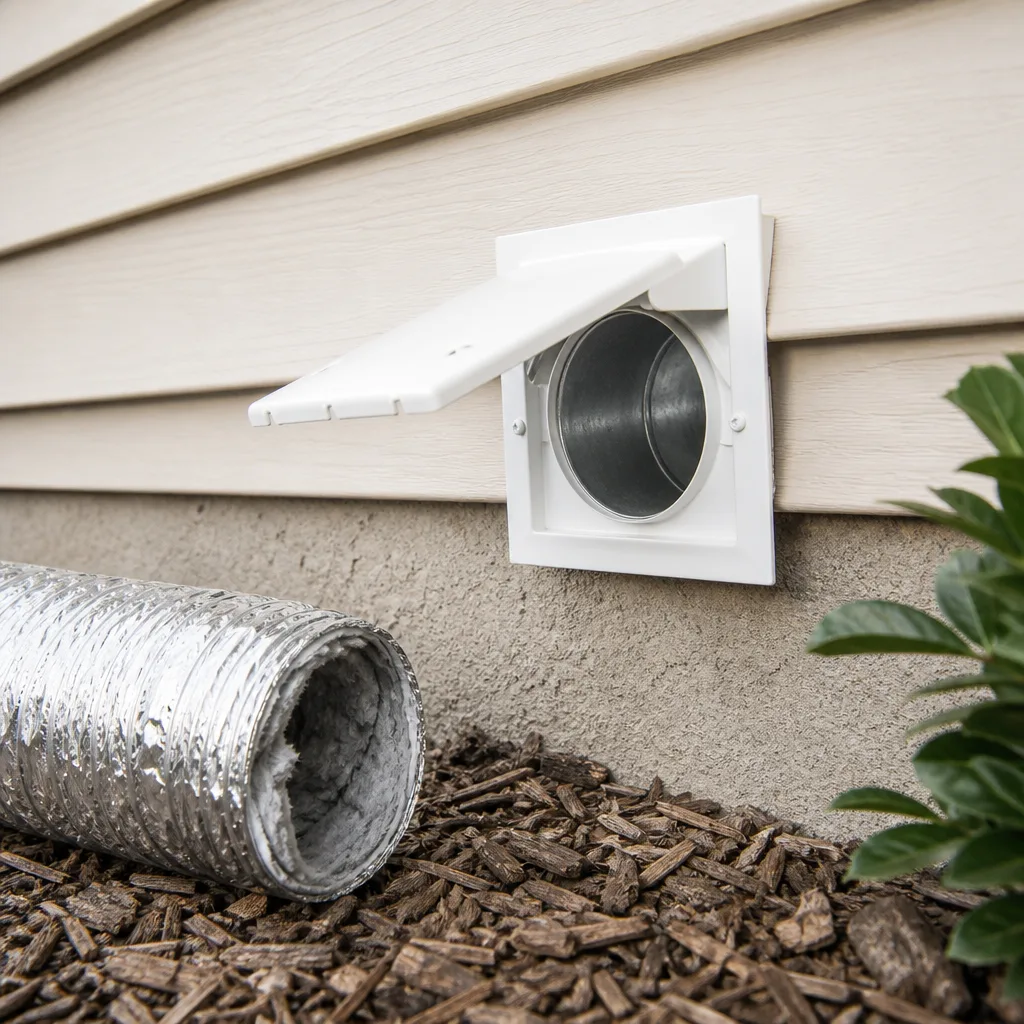
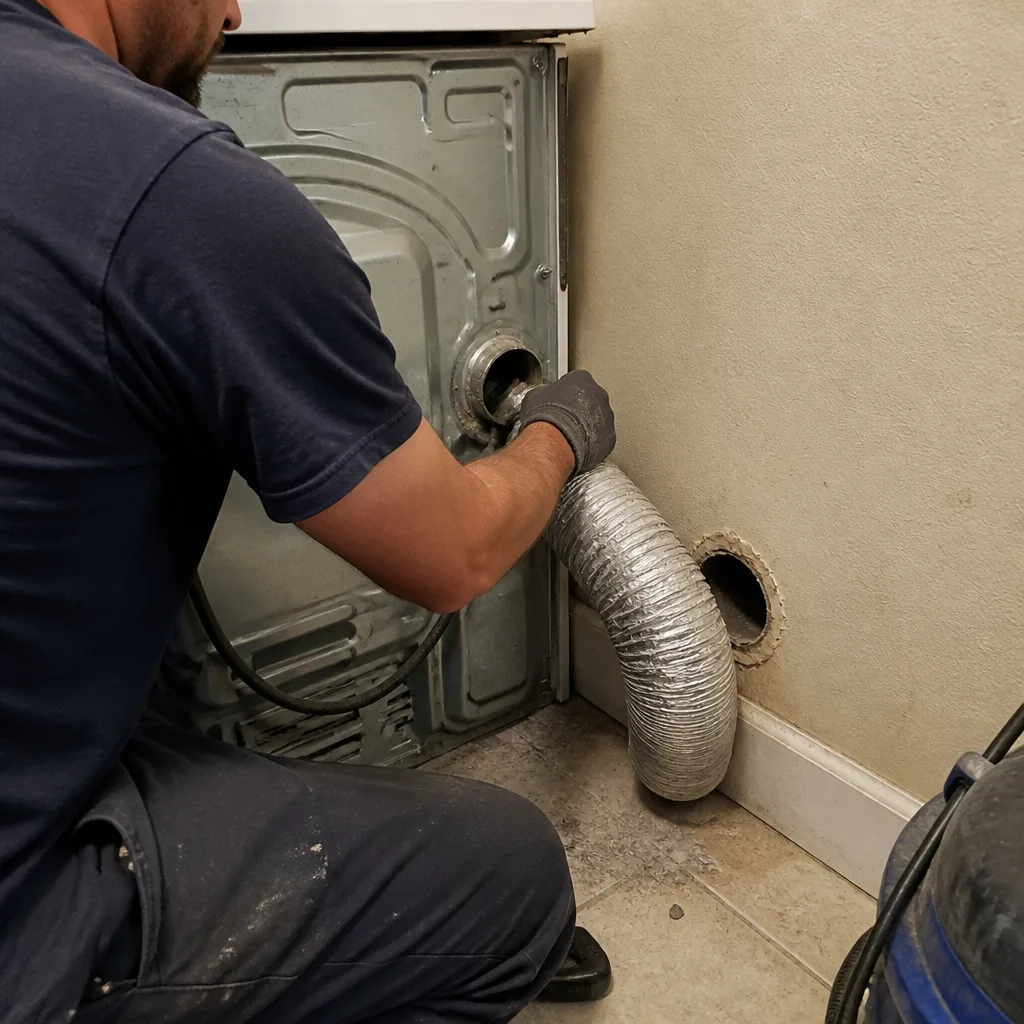
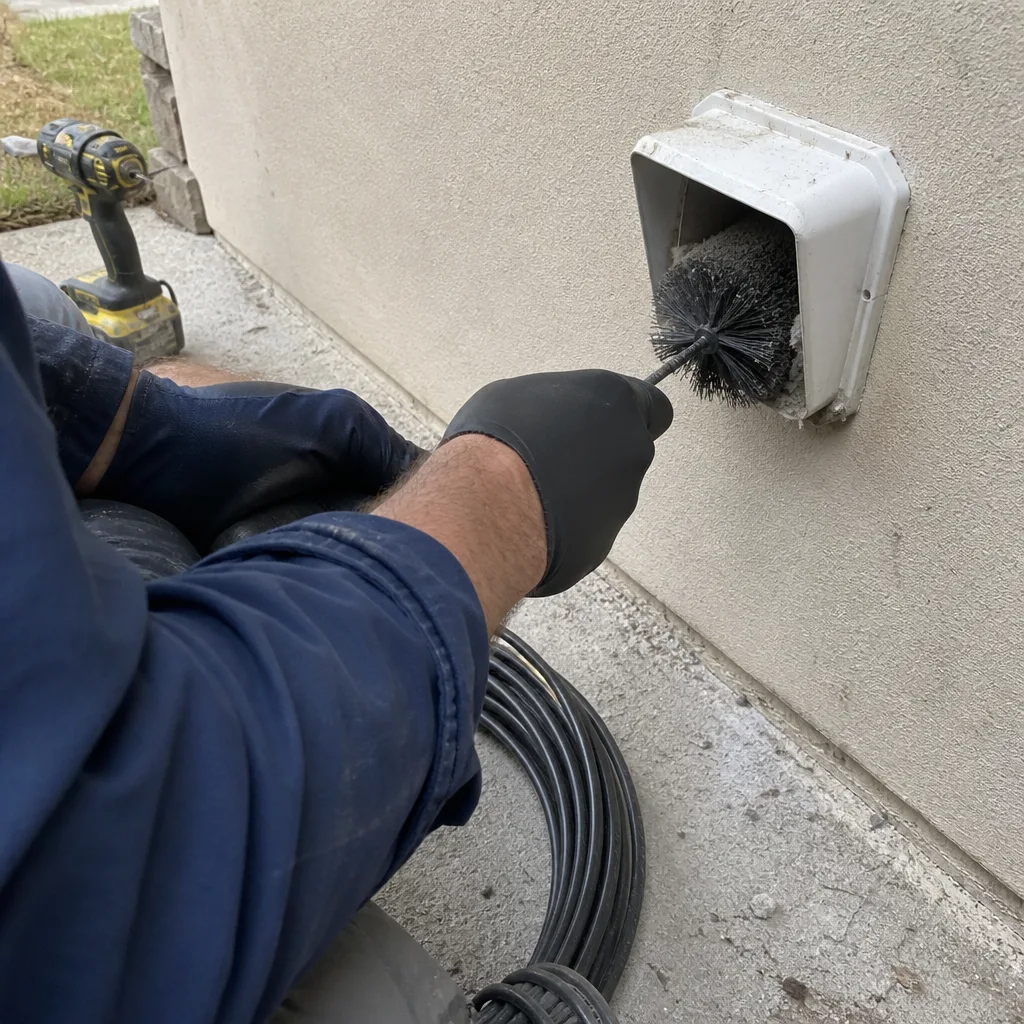
Yes, if it’s due. Dryer vent cleaning in Plano is a separate service with its own safety imperative - lint accumulation is a leading cause of residential fires. The same crew can perform both services in one visit, with separate scopes and documentation for each. We inspect dryer vents at no charge during duct cleaning estimates and quote the work only if blockage or damage is found.
The Bottom Line
Air duct cleaning in Plano is a service you can verify or one you can trust on faith. The difference lies in documentation: a written scope before work, photographic evidence during, and a detailed report after. Most homeowners have never seen inside their ducts. This guide exists to change that - to establish that a legitimate cleaning produces a record you can examine, compare, and keep. The clay soil, extended cooling season, and construction history of Plano homes create genuine duct contamination issues. They also create genuine opportunity for companies willing to document their work. At CleanRun, we’ve built our practice on this principle since 2013. The equipment we use - Rotobrush, Nikro, Abatement Technologies, Honeywell, Aprilaire - is named so you can verify it. The price we quote is written so you can enforce it. The photos we deliver are yours to keep. That’s what a documented, verifiable air duct cleaning looks like.
Ready for a written estimate? Call CleanRun Air Duct Cleaning Plano at (469) 452-7766. We’ll inspect your system, show you what the camera finds, and deliver a flat price in writing before any work begins. Air duct cleaning in Plano should be accountable. We built our business to make it so.
Written by Tomas Reyes, Owner at CleanRun Air Duct Cleaning Plano, serving Plano since 2013.